
Ben Hill Tax Record Fields
Ben Hill tax records divide by function. The Assessor and Board of Assessors build the valuation roll. The Tax Commissioner takes the finished digest and handles bills, payments, delinquency, and collection. The SGRC map adds parcel, district, and technical value fields. None of that substitutes for a deed or a private appraisal. Those answer different questions entirely.
| Field | What It Shows | Where |
|---|---|---|
| Fair market value | County estimate of full value for the tax year | Assessor and QPublic |
| Assessed value | Tax assessment base, normally 40 percent of fair market value | Assessor roll |
| Exemption or covenant | Approved homestead or special-use treatment | Assessor record and application |
| Tax district | District context used with the applicable levy | GIS and tax records |
| Bill and payment | Amount billed, receipt, balance, or delinquency status | Tax Commissioner |
| Tax sale or excess funds | Collection event and a recorded claimant's possible interest | Tax Commissioner and Clerk |
Georgia law assesses most property at 40 percent of fair market value. Statutory exceptions exist. A mill equals one tax dollar per $1,000 of assessed value. Exemptions and special programs shrink the taxable base. The bill is not a sale price. A county value is no promise of what a buyer would pay.
Ben Hill Assessor Roll Access
The QPublic property search entry is the natural first stop for the Ben Hill roll. Its notice states that assessment information reflects the last certified tax roll. Other data may change. Use it to confirm the parcel and the tax-roll owner of record. Confirm the published value context too. Treat the technical GIS names as a guide. The live card may label fields differently.
The public GIS value layer exposes current, previous, return, and market fields. It also holds historic-year, exemption, current-use, tax-district, sale, owner, mailing, and account-status fields. It is a rich cross-check. A field may sit blank, coded, or renamed. Contact the Assessor at 113 South Sheridan Street, (229) 426-5147 when a value, exemption, owner, or tax year needs explanation.
Review the Ben Hill assessment-search notice before relying on the roll.
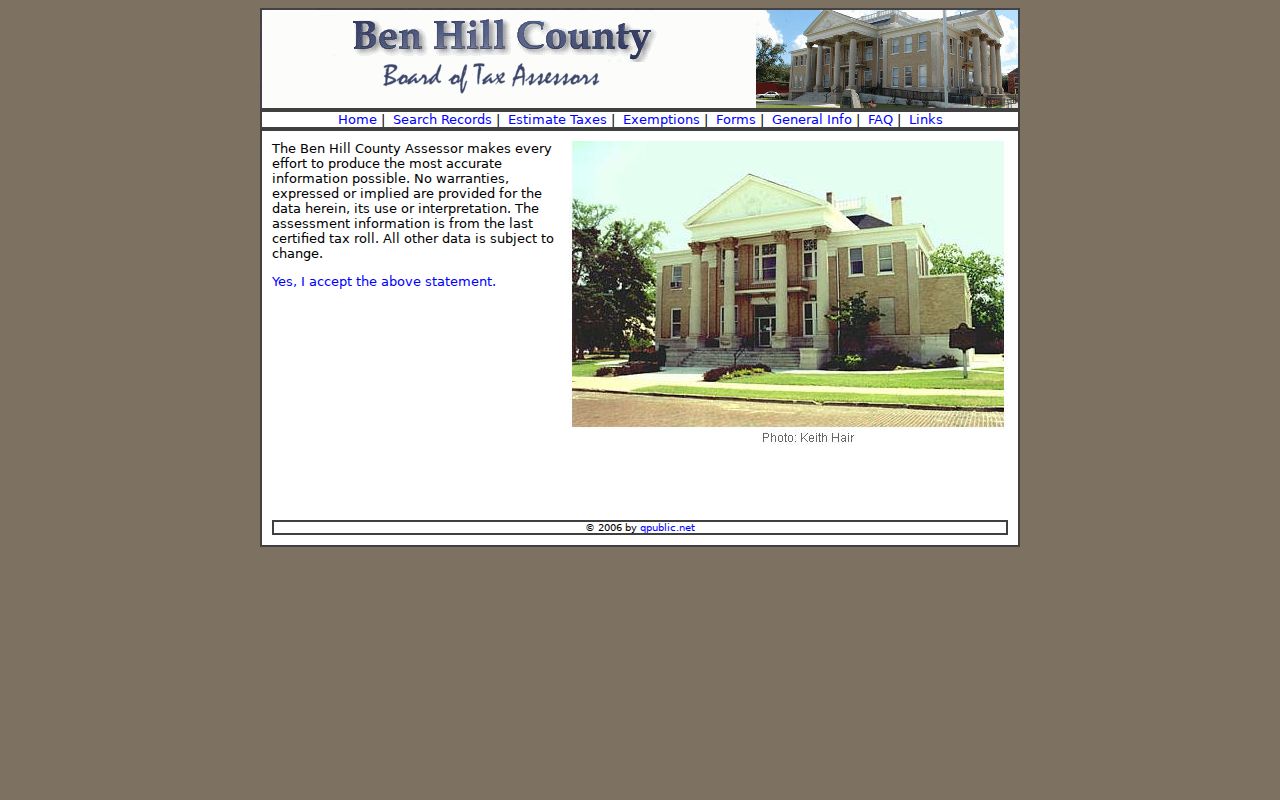
The notice separates certified assessment data from facts that may change between tax rolls.
Find a Ben Hill Tax Bill
The Ben Hill Tax Commissioner site links to Search & Pay through Government Window. That service runs live. Its fields, layout, and fees can change. So begin with the address or parcel, confirm the tax year and owner of record on the account, and check any online-payment fee on the screen itself.
- Find the parcel and tax year in QPublic or the SGRC map.
- Follow the Tax Commissioner's official Search & Pay link and enter the supported key.
- Match the returned account to the parcel, owner, and year before reading the balance.
- Compare exemptions and assessed value against the Assessor's roll.
- Call (229) 426-5144 for a receipt, delinquency, tax-sale, or balance question the portal does not answer.
- Assessed value
- The statutory portion of fair market value used as the tax base, subject to exceptions.
- Mill rate
- Dollars of tax applied per $1,000 of assessed value.
- Homestead exemption
- An approved reduction under a homestead program; the record flag alone does not prove present occupancy.
- Tax lien
- A recorded claim tied to unpaid tax, which should be checked with the Tax Commissioner and Clerk.
The Tax Commissioner's office sits at 324 East Pine Street in Fitzgerald and lists weekday hours from 8 a.m. to 4:30 p.m. Payment problems go there. So do receipts. A correction to a GIS field does not by itself change the bill.
The official Tax Commissioner profile confirms the office route and links to tax services.
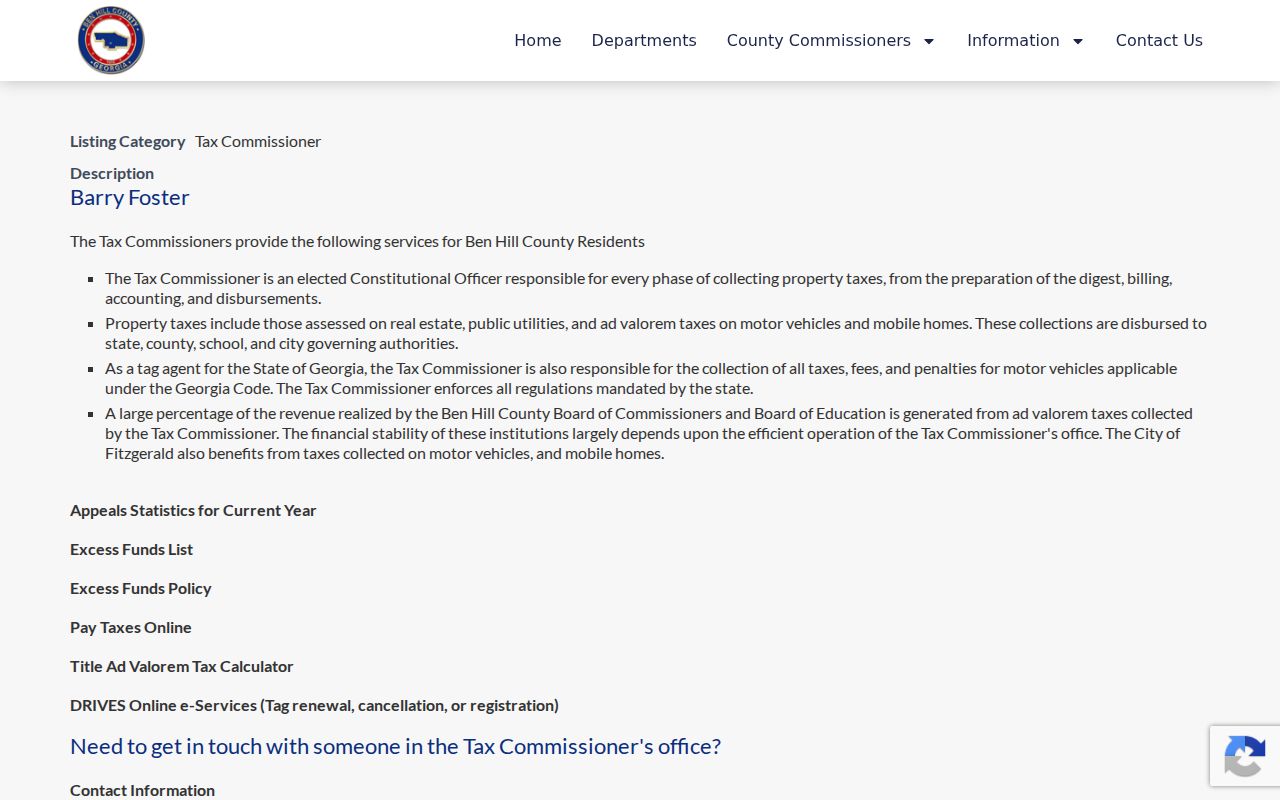
Use the office page when the bill search stalls or a receipt needs review.
Ben Hill's Forty-Percent Rule
The Georgia Department of Revenue valuation guidance defines fair market value through an arm's-length deal between a willing buyer and a willing seller. Under O.C.G.A. § 48-5-7, the usual assessed value is 40 percent of that figure. The county's QPublic material repeats the same rule. The math stays simple.
Never compare the assessed figure to a sale price and call the gap an error. Check the fair market field first. Then find the assessed field, tax year, exemption, covenant, and district. Sale consideration can surface in deed records or PT-61 data, but that reports a transfer, not the assessor's annual value judgment.
Ben Hill Exemption Deadlines
The county's 2026 notice set April 1 as the deadline for homestead exemptions, real- and personal-property returns, preferential and conservation covenants, Forest Land Protection Act covenants, and mobile-home decals. Check the current notice each year. Never carry a deadline forward without confirmation. The Assessor decides filing and program questions.
The Ben Hill exemptions page lists a standard homestead amount, age-based programs, disabled-veteran and surviving-spouse relief, tax deferral, conservation use, FLPA, and Freeport. Each program carries its own proof and scope. Some hinge on age, service history, or how the land is used. A homestead flag is tax-program evidence, not a free-standing finding about who lives at an address.
| Program clue | Record to review | Point to verify |
|---|---|---|
| Standard homestead | Application and roll flag | Approval and tax year |
| Age-based relief | Current county form | Age, income, and school-tax terms |
| Conservation or current use | Application and covenant | Ten-year term and breach effect |
| FLPA | Filed covenant material | Eligibility and current deadline |
| Freeport | Business inventory filing | Qualifying personal property |
The conservation-use recording fee is $10, per the county material. Breaking the ten-year covenant can bring penalties. Keep the application, approval, recorded covenant, and final bill as separate records.
Ben Hill's Five-Year Tax Trend
The county's published 2025 digest shows a countywide trend, not any single property's value. Real and personal property value climbed from $415,985,335 in 2020 to $604,789,937 in 2025. The 2025 gross digest was $620,781,530. Exemptions totaled $116,600,264. The net digest was $504,181,266.
Net maintenance-and-operation millage fell from 16.6460 in 2020 to 14.2900 in 2025. Total M&O taxes levied reached $7,204,750 in 2025. Those figures describe the whole digest, not every Ben Hill parcel, and never replace the parcel's annual notice and bill.
Note: Countywide digest change is context only; parcel class, condition, exemptions, district, and review date can produce a different result.
Ben Hill Tax Sales
The Tax Commissioner's site posts tax-sale navigation and an excess-funds policy. A distressed parcel calls for several checks at once. Pull the current tax bill. Check the delinquency status and the Clerk's lien index. Add any court file, the recorded tax-sale deed, and the commissioner's current notice. The office publishes no delinquent list or tax-sale calendar online. Dates and amounts come only from the live record.
Georgia law shapes what happens next. Under O.C.G.A. § 48-4-5, surplus left after taxes, costs, and sale expenses becomes excess funds. The county notifies the owner of record in writing. It also notifies security-deed holders and anyone with a recorded equity interest. Third parties cannot apply on their own. A Georgia-licensed attorney with notarized authority must file for them. Unclaimed money moves to the Georgia DOR Unclaimed Funds Division after five years.
Ask the Tax Commissioner for the parcel and tax year. Also request the sale date, balance, notice, and claim status. Ask the Clerk for the recorded lien, tax-sale deed, sheriff's deed, release, or lis pendens. Each office holds a different piece of the story.
Appeal a Ben Hill Assessment
Every appeal starts with the annual assessment notice. Georgia gives the owner 45 days from its date. The owner can contest value, taxability, uniformity, or a denied exemption. File the PT-311A appeal with the Ben Hill County Board of Tax Assessors first. Neither DOR nor the Tax Commissioner is the right starting point.
The owner then picks a route. Choices include the Board of Equalization, a hearing officer, or arbitration. If the assessor changes nothing, the chosen route moves forward. Superior Court may still be an option. Keep the notice, parcel card, comparable sales records, and photos. Also keep correction requests and proof of timely filing. A gripe about the total bill is not the same as a genuine appeal. A genuine appeal covers value, taxability, uniformity, or exemption denial.
Appeal window. File with the Ben Hill County Board of Tax Assessors within 45 days of the assessment notice date. A records request does not stop that deadline.
The state PT-311A page sets out the uniform appeal route.
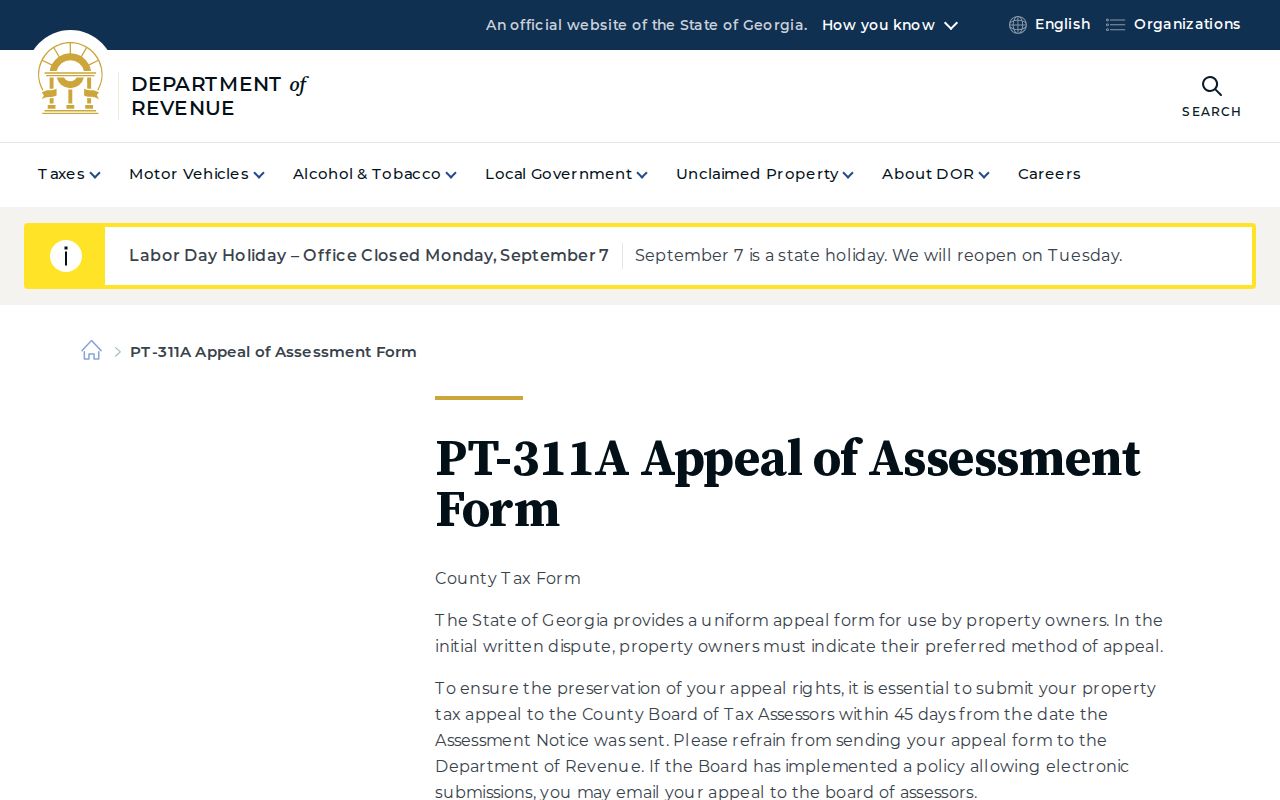
The state form supports the appeal. But the completed filing goes to the county Board of Tax Assessors first. Its 2026 calendar sets meetings for the first Wednesday of each month. They start at 8 a.m. at the assessor office. A calendar cannot promise when any single parcel comes up. Confirm the hearing date and submission needs with the Board directly.
Correct Ben Hill Tax Records
Send a mistake to the office that owns it. Owner, value, exemption, and assessment-notice issues belong to the Assessor; bring the parcel number and tax year. Bill, payment, receipt, and delinquency questions belong to the Tax Commissioner, with the account, year, payment date, and receipt in hand. A recorded deed or lien error goes to the Clerk and may take a corrective instrument, a release, court action, or legal advice.
When a record is not indexed, the Georgia Open Records Act offers a fallback for an existing assessment notice, board record, map, tax ledger, or administrative file. Ben Hill County's form sets 25 cents per copy. The first 15 minutes are free, then permitted staff time applies. Agencies must generally produce the record or explain availability within three business days.
Keep any request narrow. Name the parcel, tax year, record, and date range. Do not ask the office to build a new report or certify title. For the meaning behind assessed, market, and sale figures, use the Ben Hill County property value record.