
Tracing Former Ben Hill County Property Owners by Era
Start with the newest record and work backward. That is the rule for any former-owner search in Ben Hill County. The GSCCCA index carries the recent grantor-and-grantee trail. The Clerk of Superior Court keeps the local recorded instruments plus the older books the web index never reached. A deed alone does not always tell the whole story. Plats, probate files, and predecessor-county property records can supply the missing links.
| Source | Years It Covers | Where Held | What It Shows |
|---|---|---|---|
| GSCCCA real-estate index | County table: 1987 to September 2, 2026 | GSCCCA online | Indexed parties, deed type, date, and recording references |
| Local deed and grantor/grantee books | Earlier than the online range | Clerk of Superior Court | Earlier conveyances and their book/page links |
| GSCCCA plat index | Online county range begins in 2004 | GSCCCA and Clerk | Plat/map, land lot, district, subdivision, and slide clues |
| Predecessor-county and archival sources | Before Ben Hill County's 1906 creation | Irwin or Wilcox clerks, Georgia Archives, FamilySearch | Older ownership, survey, estate, and land identity |
For a transfer inside the online era, search GSCCCA first. Then verify the image or order a copy from the Clerk. Earlier former owners call for a different route. Take the last known book/page, the legal description, and the party names straight to the Clerk's deed records instead of treating the web cutoff as the start of the paper trail.
Ben Hill County's Online Deed Window Starts in 1987
The GSCCCA good-through table lists Ben Hill real-estate index data. Coverage runs from January 1, 1987 through September 2, 2026. The name-search form adds a broader central-index notice beginning January 1, 1990. Treat those dates as coverage clues, not as proof of when county deeds began. They simply mark where a digital name search may stop working.
Read the coverage precisely. Try the Ben Hill county range first. The Clerk can help after that. Ask for the older grantor/grantee books and deed books that sit outside the index. No official source records a courthouse-fire loss here. So a failed web result is not a destroyed record. It may be an older paper entry. It may be a name variant or an instrument indexed under another party.
Note: Preserve both GSCCCA date statements when documenting coverage because one is county-specific and the other describes the central system.
How Deed Types Change a Ben Hill County Former-Owner Story
Not every change of title is an ordinary purchase. The GSCCCA instrument menu spans warranty, quitclaim, trustee, sheriff's, tax-sale, estate, foreclosure, gift, and right-of-way deeds. Security deeds round out the list. A security deed reflects financing, not a true sale of ownership. A release can clear an earlier claim. An estate deed may point to a probate file. The file may explain who had authority to convey the parcel.
Always read the instrument label before adding a name to a former-owner timeline. A quitclaim deed conveys whatever interest the grantor holds, if any. It promises nothing about clean title. A sheriff's or tax-sale deed calls for the related sale record. When an estate appears, the Ben Hill Probate Court may hold the will. The appointment, petition, or inventory may also be there. The recorded deed itself stays with the Clerk.
Legal Descriptions Keep Ben Hill County Prior Owners on the Same Land
A shared surname proves nothing about land. Two index entries can carry the same name and describe entirely different ground. The legal description does the real work in Ben Hill County deed research. Compare land lot, land district, acreage, subdivision, tract, block, square, and plat reference at every step of a property search. The current SGRC parcel layer lists a parcel number and legal-description fields. That makes a handy starting cross-reference for tying an old deed record to a modern parcel.
Fitzgerald deeds lean on Colony Domain, Five Acre Tracts, wards, blocks, and squares. Street-style addresses play no role there. Rural property records can be even more compact, with brief land-lot descriptions doing the same job. A later deed may word the description differently. The retained book/page or plat citation is then the proof of continuity. Acreage shifted? Look for a split, a combination, a right of way, or a partial conveyance before concluding the chain broke.
Fitzgerald's Five Acre Tracts Link Old and New Owners
Fitzgerald's redevelopment records connect old property language to current parcels with unusual precision. One resolution names Five Acre Tracts 926 and 927. They sit in Land Lot 150, Third Land District. Another points to Five Acre Tracts 592 and 593 in Land Lot 149. That record also cites a Merrimac Village Apartments survey. A 2005 record covers 16.19 acres in Land Lot 280, Fourth Land District. It cites Plat Slide 652-J.
These details will not build a private chain on their own. They teach the method. Carry the tract, land-lot, district, and slide references into the plat index. Then compare the plat you find against each deed's legal description. This approach often beats searching by street address. The address may not have existed in that form when a former owner of record first acquired the land in Ben Hill County.
Walking a Ben Hill County Deed Chain Backward
Begin with a current assessor or GIS parcel. That gives you the present owner of record, the parcel number, and the legal description. The tax roll reflects the last certified digest. Anchor the first link with the newest recorded deed before going further. From there, treat each seller in the Ben Hill County deed records as the subject of the next acquisition search.
- Find the newest deed that names the current party as grantee, then record its date, type, and book/page.
- Read the grantor as the likely prior owner, while checking the parcel's legal description.
- Search that grantor as an earlier grantee to find how the same party acquired the land.
- Repeat through the online range, then continue from the last citation in the Clerk's older books.
- Grantor / grantee
- The conveying party and the receiving party named in a deed.
- Chain of title
- The linked sequence of instruments through which ownership passed.
- Reverse index
- An index route organized around the grantor side of recorded transfers.
- Quitclaim / warranty deed
- Different deed forms whose wording and assurances must be read, not assumed from the index.
When Ben Hill County Former Owners Lead to Probate
A former owner sometimes dies before signing a deed. The parcel then travels through probate rather than an ordinary conveyance. That route can involve a will, an executor or administrator appointment, an inventory, a petition to sell land, heirship material, and finally an executor's or estate deed. Ben Hill Probate Court publishes no online docket. A request to the office is the practical route. Give the decedent's name, a case number if known, and the parcel's address or legal description.
Keep the two record sets separate. A probate file shows who had authority to act on the estate. The Clerk's recorded instrument shows the conveyance entered in the real-property record. A death record can separate people with similar names. Access and certification rules still apply. State what each document proves. Leave gaps visible.
No deed may appear under the deceased owner's exact name. Try the estate, executor, administrator, and heir names found in the probate file. Return to the land description and recording reference so the search stays tied to the parcel, not to a broad hunt for living people.
Crossing Ben Hill County's 1906 Jurisdiction Line
Ben Hill County was created in 1906 from Irwin and Wilcox counties. A tract keeps its land identity. Only the custodian changes. Once the chain reaches 1906, copy every land lot, district, acreage, and plat clue. Take those details to the predecessor county's clerk or an archival catalog next. Some Fitzgerald records say "formerly Irwin, now Ben Hill County" outright, a direct routing clue. The Georgia Archives research page points to the Virtual Vault, FamilySearch, and the General Name File. It also names the General Name File. Its district plats may add survey context. Treat the collection as a finding aid rather than a complete subdivision index. Search archived material alongside the last deed-book citation instead of a historical surname alone.
Seeing the Ben Hill County Grantor Search Form
The GSCCCA real-estate name search offers fields for party type, instrument type, county, and search name. Optional date ranges and table controls narrow the results. This official form is where a backward chain begins.
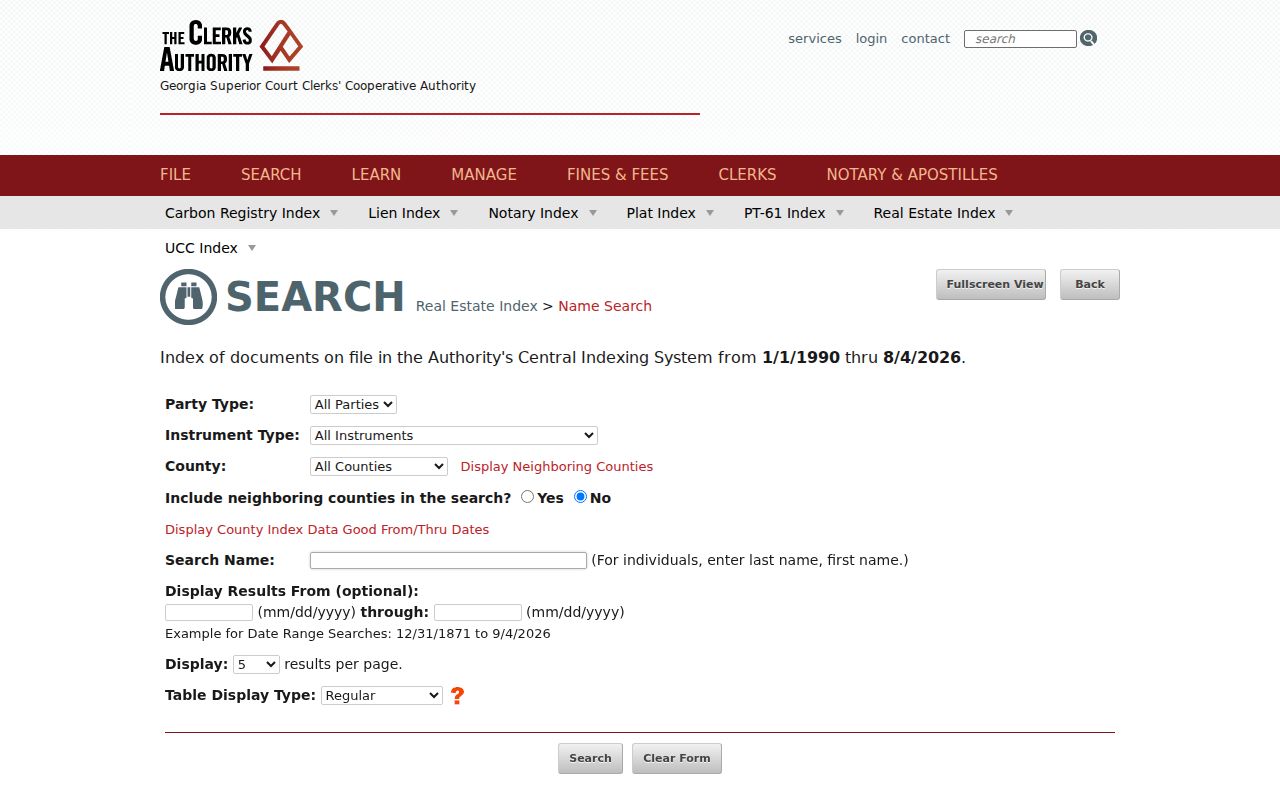
The form is an index gateway. It is not a title opinion. Use its names and references to identify instruments, then inspect the deed and confirm a certified copy with the Clerk when the purpose calls for one.
How Far Back Ben Hill County Ownership Records Go
Ben Hill County's public online trail reaches into the late twentieth century. The local chain goes further back. It runs through older Clerk books and then across the county's 1906 creation line. No official source publishes a single earliest deed-book date. Follow verified citations until the web index ends. Request the next book at the Clerk. When the legal description points across the 1906 line, test Irwin or Wilcox records and archival sources next.
An index list may omit an image, a probate event, a corrective instrument, or an interest that needs legal review. A formal title conclusion takes qualified professional help. It also requires the complete recorded chain. For the mechanics of obtaining one instrument, see the Ben Hill County deed records page.
Lawful use. Research prior owners for house history, title work, and property diligence. Never use public names or addresses to stalk, harass, or harm a person.