
Three Ben Hill County Property Value Records Compared
Three records can each claim to show value. The tax assessor, the GIS parcel layer, and a recorded conveyance answer different questions about the same Ben Hill County land. Identify the source and its date before comparing parcels or reading any number as a sale price.
| Value Type | What It Means | Where It Is Recorded |
|---|---|---|
| Fair market value | The assessor's estimate under Georgia tax standards | Tax Assessor / QPublic and GIS |
| Assessed value | Generally 40 percent of fair market value, subject to exceptions | Tax Assessor's certified roll |
| Last sale or consideration | A transaction amount tied to a recorded transfer | Deed, PT-61 data, and populated GIS sale fields |
| Program or taxable value | A figure affected by exemptions or special-use treatment | Assessment and exemption records |
For most Georgia property, assessed value is 40 percent of fair market value. A statutory program can change that. A recorded sale documents one transaction on one date, so it is not the assessor's current appraisal, and a gap between the two figures is rarely a mistake in either record.
Georgia's 40 Percent Level Shapes Ben Hill County Assessed Value
Georgia Department of Revenue guidance and the Ben Hill QPublic general-information page explain the ordinary relationship: fair market value is set as of January 1, and assessed value is 40 percent unless a statute provides another treatment. A parcel with a fair market estimate and an assessed figure is not displaying two competing sale prices.
Always retain the tax year. Assessment work is annual, and QPublic warns that its assessment information comes from the last certified tax roll while other data can change. The county did not publish a precise portal-refresh cycle or routine lag after a closing, so no instant update should be assumed.
Ben Hill County GIS Stores Current and Historical Value Fields
The SGRC value layer is dense. Fields include return value, current value, and previous value. It also carries market-value and sale-value components plus several historical-year and historical-value entries. Land lot, district, zoning, tax district, owner, mailing, subdivision, exemption, and account-status fields round out the layer. That structure lets you compare like with like. A blank sale field proves nothing. It only means the mapped field holds no value for that record or view, and a historical GIS field is a tax-data clue rather than a retrospective market appraisal. Copy the field label and year instead of flattening every figure into one generic home value.
Where Ben Hill County Last-Sale Information Comes From
Last-sale figures live in the recorded transfer itself. The Clerk records real-estate instruments for Ben Hill County. GSCCCA supports deed, grantor/grantee, PT-61, book/page, property, and sale-price search functions where available. Any last-sale or consideration amount belongs to that single transaction. Read it alongside the deed type. A gift, estate, quitclaim, foreclosure, sheriff's, or tax-sale deed may not reflect an ordinary market bargain. Match a transfer to the right land using the legal description and parties, and treat the deed plus PT-61 trail as documentary context even when the assessor or GIS carries a sale-related field. No transfer amount is an estimate of today's price.
See the Ben Hill County Assessor Entry Page
That notice matters. The Ben Hill County QPublic search page states that assessment information comes from the last certified tax roll, and the screenshot displays the official gateway to the parcel search.
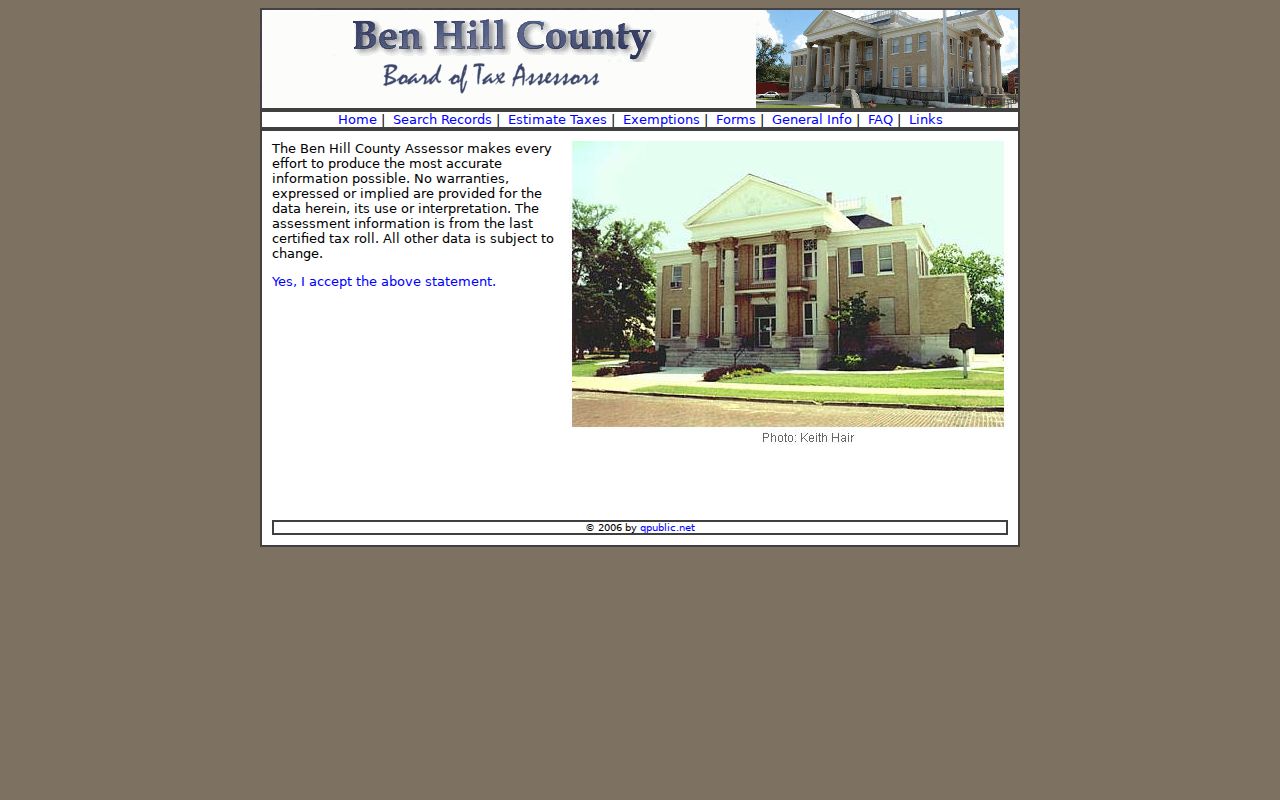
The acceptance notice is context for every figure copied from the portal. Record the tax year. Use a newer deed to dig into ownership or transaction data rather than to overwrite the assessor's certified value field.
Looking Up a Ben Hill County Property Value
Start at the assessor portal. Pin down the exact parcel before reading any figure. The parcel number and legal description are the strongest cross-office keys, especially for rural Ben Hill County tracts that lack a simple street address.
- Search the address or owner in QPublic; use SGRC to recover the parcel number if an address fails.
- Confirm the parcel and note the tax year, fair market estimate, assessed figure, and exemptions.
- Review historical value fields only when their year and label are clear.
- Check the deed or PT-61 trail when the last transaction amount is relevant.
- Assessed value
- The statutory percentage applied for the property-tax assessment.
- Fair market value
- The assessor's January 1 estimate under Georgia standards.
- Assessment ratio
- The link between fair market and assessed value, ordinarily 40 percent in Georgia.
- Sale consideration
- The amount associated with a recorded transfer, not automatically a current appraisal.
- Reassessment
- The process of updating the value carried for a tax year.
Exemptions Can Change a Ben Hill County Taxable Number
Exemptions change the tax side of a parcel record. They do not turn the reduced figure into a market estimate. Ben Hill County materials describe a long menu of programs. Standard homestead, age-based, disabled-veteran, conservation use, current use, Forest Land Protection Act covenants, deferral, and Freeport appear on the list. Each one carries its own rules and records. Do not infer personal facts from an exemption flag. A conservation or current-use figure may sit under a covenant. That comparison misleads. For bills and appeals, see the Ben Hill County property tax records guide.
Ben Hill County's 2020 to 2025 Digest Gives Context, Not a Home Price
Ben Hill County's 2025 digest spans five years of growth. Real and personal property value climbed from $415,985,335 in 2020 to $604,789,937 in 2025. Gross digest reached $620,781,530. Exemptions totaled $116,600,264, leaving a net digest of $504,181,266. These are countywide aggregates produced for the levy process. No parcel rose at one shared rate. The digest cannot establish a Fitzgerald-only value, neighborhood appreciation, or one house's selling price, so return to the parcel's own tax year, characteristics, exemption status, and recorded transfers.
Note: County digest totals combine broad classes of property and should never be divided into an assumed value for one parcel.
Correcting a Ben Hill County Property Value Record
Wrong owner, value, exemption, or parcel detail? Bring the parcel number and tax year to the Ben Hill County Board of Tax Assessors. Ask to see the assessment notice and any support on file. Staff can explain the correction process and what the board must approve. Georgia's PT-311A appeal route stays open for 45 days after the notice. Simply asking for a record, though, may not protect your appeal rights.
Keep the routes straight. The Tax Commissioner handles tax bills and payments. The Clerk of Court holds deeds, plats, and liens. A GIS map label can look wrong. SGRC or the county GIS custodian handles the display. Fixing a map label, though, never changes the legal description or the assessment itself.
Permit Work May Later Affect Ben Hill County Property Value
Ben Hill County's Tax Assessor runs countywide inspections, and properties with building permits are included. That connection matters. A finished improvement can show up later in land, building, or value records. But a permit date is not the effective date of a new assessment. Inside incorporated Fitzgerald, the city issues building permits and handles inspections. The resulting assessment record stays with the county.
Construction can drive a value change. Pull the city permit and inspection file by address and parcel number. Then set it beside the county assessment notice for that tax year. Outside the city limits, confirm which county office holds the file before you ask. A permit category alone can't tell you an improvement's cost or its value impact. Only the actual record can.
What a Ben Hill County Assessed Value Does Not Tell You
An assessed value exists to support the tax system. Nothing more. It is not a promise of what a buyer will pay. It is not a lender's valuation. It is not a boundary survey. And it is not a title opinion. Condition, timing, financing, included property, and transfer type can all push a sale price away from the tax record. A licensed appraisal answers to a specific purpose and effective date.
QPublic's notice about the last certified roll adds another caution. A recent improvement or transfer may not appear the same way across every system. Cite the source and year. Compare matching value types. And let unknowns stay unknown rather than filling gaps with an automated estimate.
Value vs price. A Ben Hill County assessed value serves taxation and is not a predicted sale price. Obtain a licensed appraisal when a current market opinion is required.